 The Lahore Property Guide
Free chapter · Understanding Property in Lahore
Chapter 2: What Exactly Are You Buying?
By Adil Builders · Updated 18 September 2026
This chapter matters because the word "plot" makes property sound far simpler than it is.
If someone tells you "ten marla plot, Raiwind Road, two crore," your first reaction should not be to ask the price. It should be to ask what exactly this ten-marla thing is.
A piece of land, a plot in an approved housing scheme, a plot file, an allotment and a possession plot can all be described casually as a "plot," while representing very different things.
So build this from the ground up.
Start With the Most Basic Distinction
There are essentially two worlds to tell apart.
World A is the underlying land. Actual land, existing physically: a ten-marla piece of ground somewhere near Raiwind Road. It has some relationship to the revenue and land-record system.
World B is a developed housing scheme. A developer or society takes a larger piece of land and creates a planned development out of it:
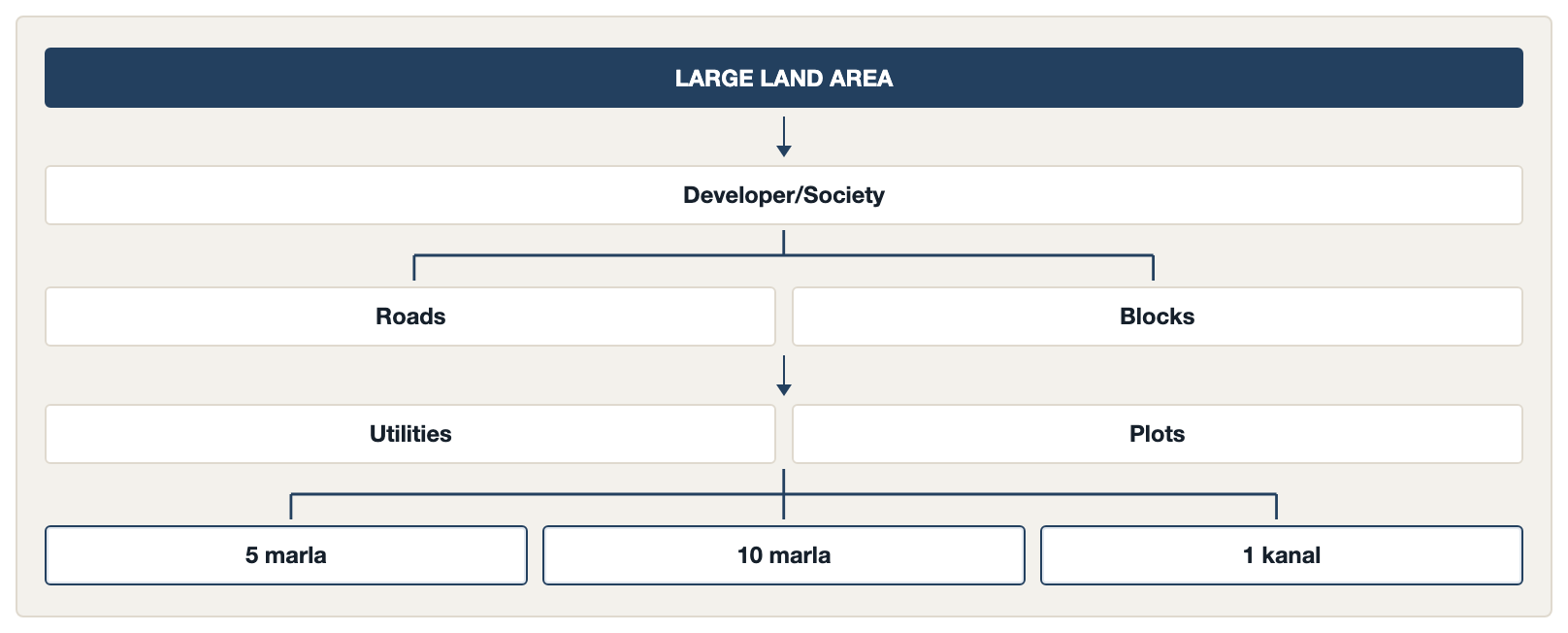
In World B you are no longer merely dealing with land ownership. You are also dealing with the development scheme, the approved layout, plot numbering, allotment, society records, transfer procedures, possession, development charges, and potentially an NOC and approval framework.
Which is why the first question is always: what kind of property is this?
Type One: Ordinary or Revenue Land
Start with the simplest conceptual example.
Imagine someone owns five acres of agricultural land near Raiwind Road. The land exists physically, and its ownership and identification are connected to the revenue and land-record system.
Here you will encounter concepts such as Khasra, Khewat, Khatooni, Fard, Registry and mutation or Intiqal. Do not worry about memorising them yet; Chapter 3 exists for exactly that.
For now:
Revenue land is the underlying land as recognised in the land and revenue record system.
But What If the Owner Divides It Into Plots?
Now imagine that owner announces he has five acres and is going to divide them into ten-marla residential plots.
On paper this sounds simple. In practice it is where the complexity begins.
He is no longer merely selling pieces of land. He is proposing a development, a layout and a use of land, and there may be planning and development requirements that have to be satisfied first.
Owning land does not automatically mean you can turn it into a housing scheme and sell residential plots however you want.
This is one of the most important distinctions in the entire guide.
Type Two: A Plot Inside a Housing Scheme
Now suppose instead that you buy ten-marla Plot 123 in XYZ Housing Scheme.
This is a different situation, because there may be two parallel records running at once.
The underlying land. The society or developer has land associated with the scheme, recorded in the revenue system.
The society's internal plot records. The society may separately record Block A, Plot 123, ten marla, allotted to Mr. Ahmed, along with transfer history, possession status and development charges.
So your transaction may involve both the underlying legal land framework and the society's own administrative system.
This is why you cannot assume that because the society's file says Ahmed owns Plot 123, you are finished. You need to understand what legal interest that document actually represents.
Where "File" Enters the Picture
You will hear this term constantly in Pakistani property markets: a "ten-marla file."
A beginner might assume that is basically a plot. Not necessarily.
A file can represent an entitlement or allotment position in a development rather than a particular, physically possessed plot.
Imagine a developer offers you a ten-marla file. You might have documentation showing that Mr. Ahmed has a right to receive a ten-marla plot under certain terms. That is not the same as saying: here is your physically identified Plot 123, sitting on the ground.
That is an enormous difference.
Think of It Like a Cinema
A ticket gives you a right to a seat according to the terms of the ticket.
An actual seat is Row G, Seat 14. You can point at it.
A property file is conceptually closer to the ticket. An identified, possessed plot is closer to the seat.
That is a simplification, and the exact legal meaning depends on the scheme and its documents, but the analogy holds well enough to be useful.
Type Three: Allotment
Which brings us to another term.
Allotment Letter
An allotment generally means that a society or developer has allocated a particular property or plot entitlement to someone. The allotment letter is the document evidencing that allocation: typically naming the scheme, the block, the plot number, the area and the allottee.
That is more specific than saying "Ahmed owns a ten-marla file." But do not jump from there to "allotment letter equals full ownership." That is far too simplistic.
You still need to establish:
- Who issued the allotment?
- What authority does that entity have?
- What exactly does the allotment document grant?
- Is the plot physically identifiable?
- Has possession been given?
- Has the plot been transferred?
- Are there outstanding charges?
- What does the underlying land record say?
- What does the scheme's approval status say?
The principle from Chapter 1 applies again: one document answers one question. It does not automatically answer every question.
Type Four: Possession
Another word you will hear constantly, usually as "possession mil gayi hai."
Possession essentially means the developer or society has reached a stage where the allotted plot can be physically handed over and occupied according to its rules.
So the sequence tends to run:
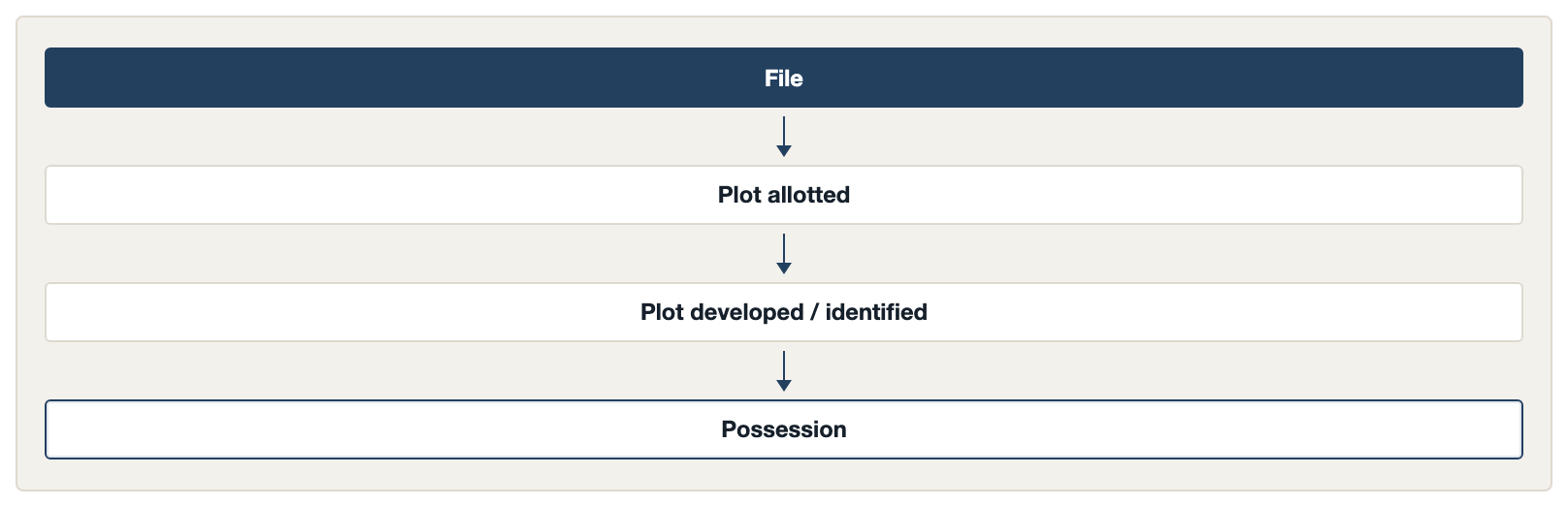
These are not universal stages for every development, and schemes can structure them differently, but it is a useful mental model.
Why Does Possession Matter?
Because there is a large gap between "I have a document saying I am entitled to a ten-marla plot" and "I can physically identify my ten-marla plot on the ground, and the society has handed it over to me."
The second gives you far more physical certainty.
But:
Possession alone does not prove that everything about the property is legally clean. You still need to investigate ownership, approvals, transferability and encumbrances.
Your First Property Ladder
Keep this model in your head:
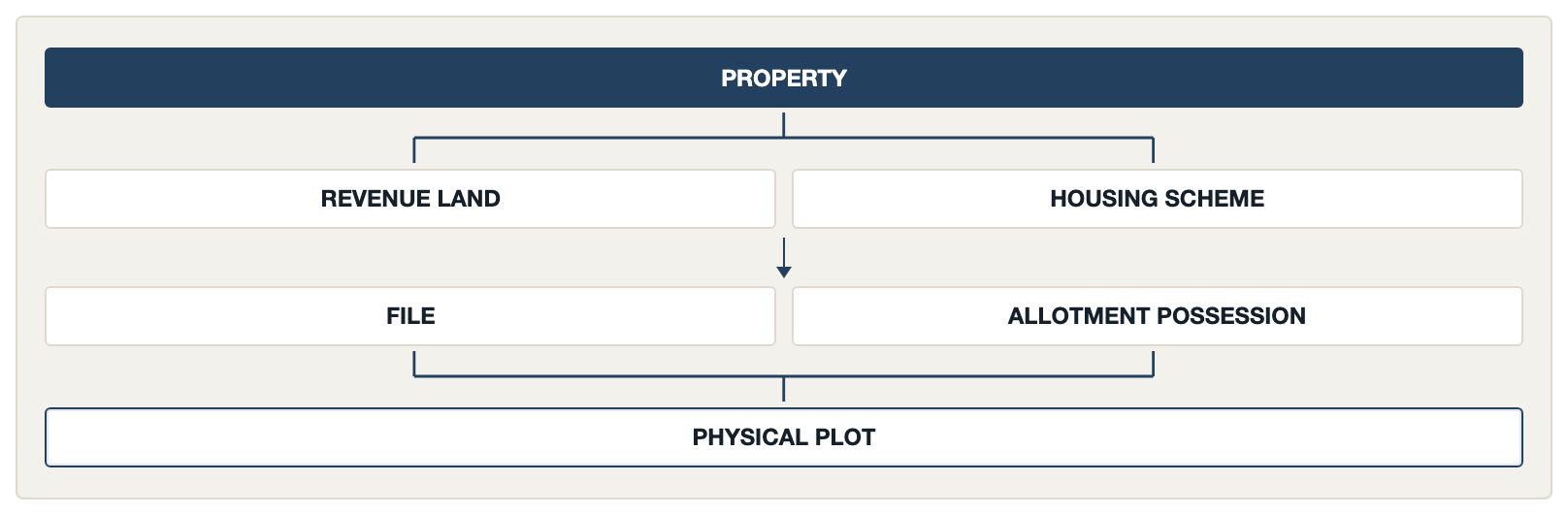
Again, this is a learning model rather than a universal legal sequence. Real developments can skip stages, combine them, or structure them differently.
The Most Dangerous Confusion: Plot Against File
Suppose two property dealers approach you on the same day.
Dealer A: ten-marla plot, Rs. 1.5 crore.
Dealer B: ten-marla plot, Rs. 90 lakh.
You might conclude that Dealer B is offering a bargain.
But perhaps Dealer B is selling a ten-marla file, while Dealer A is selling a developed, possession-ready, physically identifiable plot. Now the price difference makes rather more sense.
So whenever you hear "plot for Rs. X," the first question is:
Is this a file or an actual allotted and identified plot, and is possession available?
That single question prevents a great deal of confusion.
Residential Against Agricultural
Return to Raiwind Road.
Suppose someone offers two kanal of land there, marketed as an excellent investment on which to build a farmhouse.
Do not assume you can buy it and build a house. You first need to establish the land's legal classification and permitted use. Is it agricultural, residential, commercial, part of a housing scheme, part of a farmhouse-related development, or something else?
Owning land and being allowed to use it for your intended purpose are separate concepts.
This is where planning and development regulations become relevant, and Chapter 6 takes them up in detail.
The Situations You Could Meet on One Road
The introduction explained why Raiwind Road is used as the running example throughout this guide. This chapter is where that choice starts paying off, because the classification problem is exactly what the corridor puts on display.
Along it, you could encounter any of the following:
- An individual selling agricultural or revenue land.
- An approved housing scheme selling residential plots.
- A private development operating an allotment system.
- A plot being resold by an existing allottee.
- Someone selling a file.
- A development whose approval status requires careful investigation.
The due-diligence process changes depending on which of those you are looking at. That is precisely why there can be no single universal list of "the documents you need." You classify the property first, and the document list follows from the classification.
One More Concept: Chain of Title
You will hear this phrase from lawyers.
Chain of Title
How ownership, or the right to the property, moved from the original owner down to the person standing in front of you.
Imagine it as a sequence:
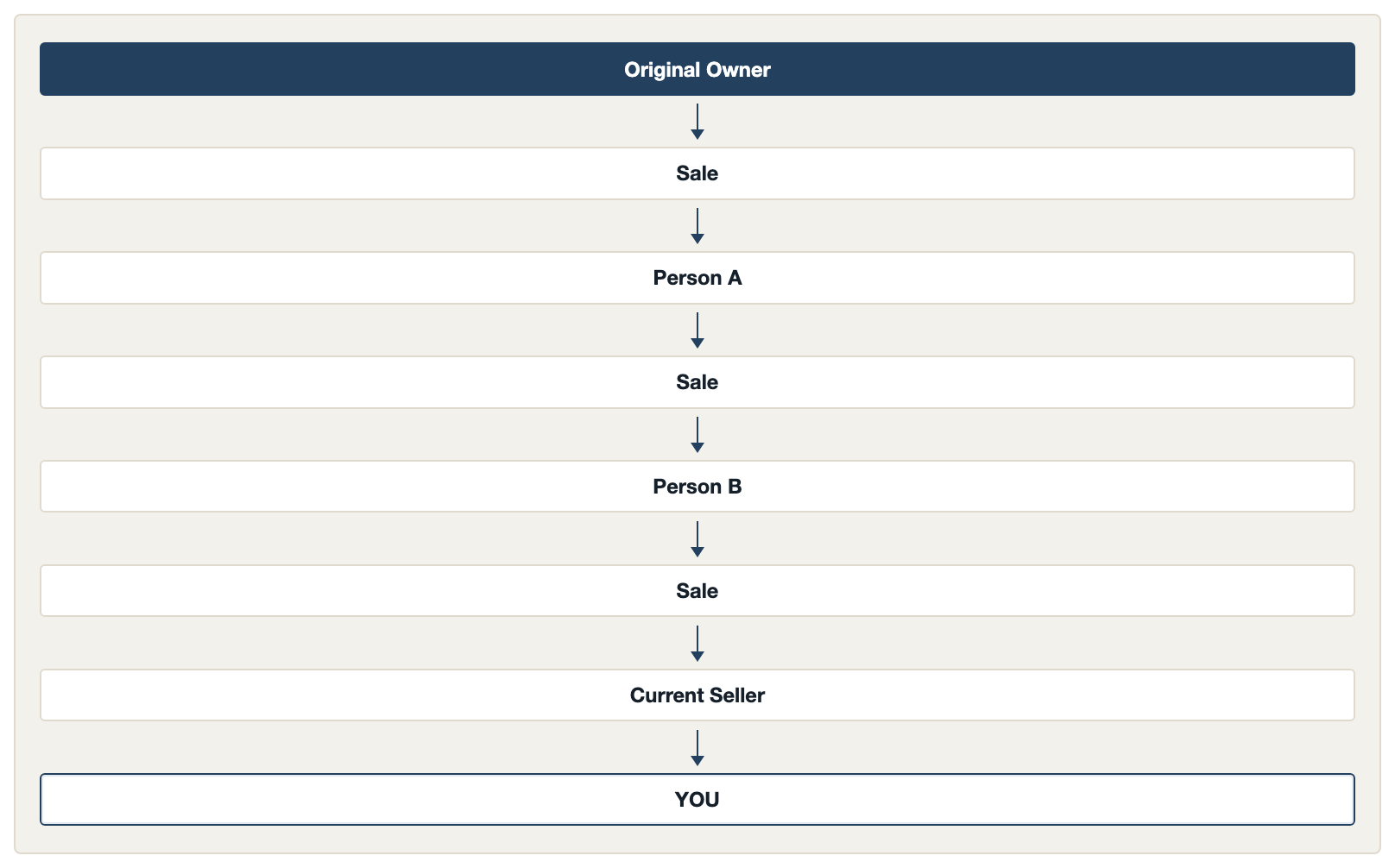
You do not want to look only at the final link, from the current seller to you. You may need to understand the whole historical chain behind the seller's claim.
This becomes especially important with older property, inherited property, multiple past transactions and powers of attorney. Chapter 4 goes into it properly.
The Three Questions That Should Become Automatic
Whenever someone shows you property, train yourself to ask three things.
- What exactly is it? Revenue land, society plot, file, allotted plot, possession plot?
- What exactly does the seller own? Physical land, an allotment, a transferable entitlement, something else?
- What exactly will I receive after buying it?
The third is the big one, and note how it is phrased. Not "what documents will you give me," but "what legal or property interest will actually become mine." Those are very different questions, and only one of them is hard to answer dishonestly.
A Realistic Example
Imagine you meet a dealer who says: "Sir, ten marla plot in ABC Society, Raiwind Road. Owner needs urgent cash. Rs. 1.8 crore."
You now know enough not to start negotiating. You start interrogating the property instead.
- What is it? Actual plot or file? The dealer says actual plot. Good, that is a start.
- Has it been allotted? Ask to see the allotment.
- Is possession available?
- Who owns it? Who is the current allottee or owner?
- What does the society's record say? Can the society independently verify the current status?
- What is the underlying legal status? What is the approval and NOC status of this scheme and this specific block?
- Any outstanding charges? Development charges, transfer fees, dues?
- What happens when I buy it? What is the society's transfer procedure?
Only once those questions have real answers does the conversation earn the right to move on to whether Rs. 1.8 crore is a fair price.
The Golden Rule of This Chapter
Do not ask "Is this plot genuine?" Ask "What exactly is the legal thing being sold to me?"
"Genuine plot" is vague. A sophisticated buyer asks a specific sequence instead:
- What is the underlying land?
- Who owns it?
- What right does the seller possess?
- What document represents that right?
- Is that right transferable?
- Is the development approved?
- Is this a specific physical plot?
- Has possession been given?
- What exactly will be transferred to me?
Once you think this way, Pakistani property terminology becomes much less mysterious.
Chapter 2 Cheat Sheet
| Term | Beginner's mental model |
|---|---|
| Revenue land | Underlying land recorded through the land and revenue system |
| Housing scheme | Planned development containing multiple plots |
| Plot | A defined parcel within a development or landholding |
| File | Generally an entitlement or documentary position, not necessarily a physically identified plot |
| Allotment | Developer or society allocates a plot or entitlement to someone |
| Allotment letter | Document evidencing that allocation |
| Possession | Physical handover and availability of the allotted property |
| Registry | Formal registration of a deed or transaction |
| Fard | Land-record extract, covered in Chapter 3 |
| Intiqal | Mutation or change in the revenue record, covered in Chapter 3 |
| NOC | No Objection Certificate; its significance depends on who issued it and what it covers |
| Chain of title | Historical sequence of ownership and transfers |
These are deliberately simplified learning definitions. Their exact legal effect can vary by property type, by scheme and by applicable law.
What This Chapter Established
- "Plot" is a marketing word, not a legal classification. Five very different things are all sold under it.
- Classify before you investigate: revenue land, society plot, file, allotment and possession each demand a different set of checks.
- A file is generally an entitlement, not a piece of identified ground.
- An allotment letter evidences an allocation. It is not a proof of clean ownership.
- Possession gives physical certainty, not legal certainty.
- Owning land and being permitted to use it as you intend are separate questions.
- The decisive question is not "what documents will I get" but "what legal interest will become mine."